What the floor is measured from
Every prop firm account has a maximum loss: an amount below which the account is closed and the fee is gone. The number is the part everybody compares. The part that decides whether you pass is what that number is measured from, and there are three answers.
- Static. The floor is the starting balance minus the allowance, and it stays there. On a $100,000 account with $8,000 of room, the floor is $92,000 on the first day and on the last.
- End-of-day trailing. The floor follows your highest closing balance upward and never down. A day that closes at a new high lifts the floor by the same amount; what happened inside the day does not count.
- Intraday trailing. The floor follows your highest equity, including profit on trades that are still open. A position that runs up and comes back lifts the floor permanently, even though you never kept a cent of it.
The same trades under all three
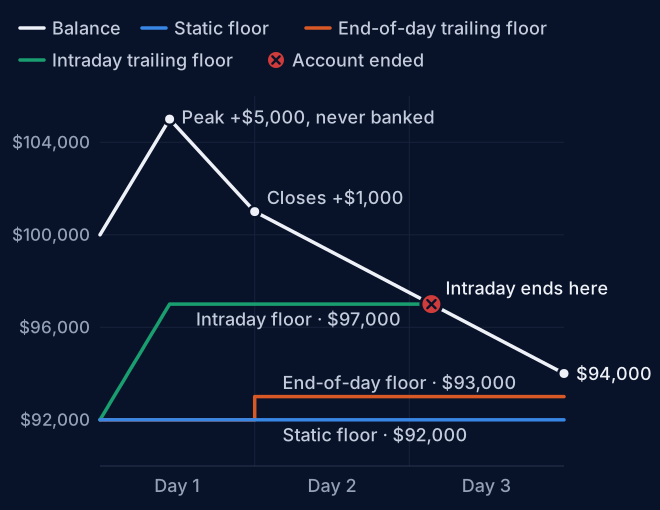
Hold everything else still — the account, the allowance, the daily limit, the trades — and change only what the floor follows. No single day below breaks the daily limit, so the only thing that can end the account is the maximum loss.
| The account | $100,000 · maximum loss $8,000 · daily limit $4,000 |
|---|---|
| Day one | Up $5,000 at its best, closes up $1,000 |
| Days two and three | Lose $3,500 each, inside the daily limit |
| Static floor | $92,000 — survives with $2,000 to spare |
| End-of-day trailing floor | $93,000 — survives with $1,000 to spare |
| Intraday trailing floor | $97,000 — ended $500 into day three |
End-of-day trailing charged this account for the $1,000 it banked. Intraday trailing charged it for the $5,000 it only saw.
Why a bigger allowance can be the smaller one
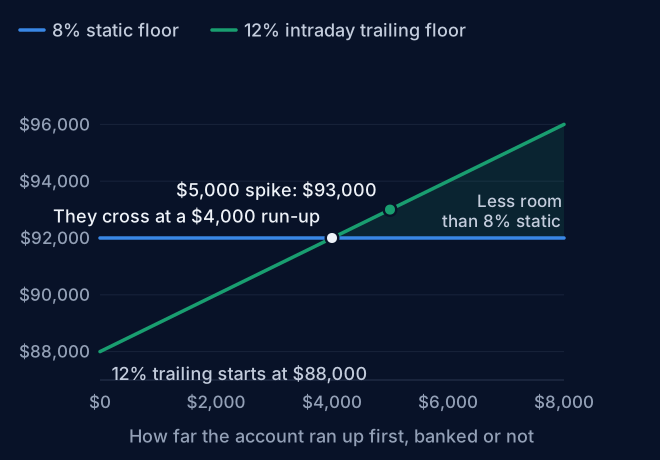
This is the part a comparison table hides. A 12% intraday trailing limit looks more generous than an 8% static one, and on the first morning it is: $12,000 of room against $8,000.
Then the account makes money. After any run-up of more than $4,000 — realised or not — the 12% trailing floor sits above the 8% static one, and it stays there. A $5,000 spike puts it at $93,000 against the static account’s $92,000. The larger number bought less room from the moment it was used.
Which firms here use which
Most of the eight firms in the prop firm rankings measure from the starting balance. Half of them were read at their own published terms; the other half were not, and a rule nobody has read where it is published is a rule to check before you pay.
| Static | 5 of 8 — FTMO, FundedNext, The5ers, FundingPips, Alpha Capital Group |
|---|---|
| End-of-day trailing | 2 of 8 — Topstep, E8 Markets |
| Intraday trailing | 1 of 8 — Breakout |
| Read at the firm’s own pages | 4 of 8 — FTMO, FundedNext, The5ers, Topstep |
The other four are as other sources report them. Breakout’s figure also predates Kraken’s acquisition of the firm and has not been re-read from the current programme.
The same firm can sell you both
FTMO sells two programmes, and they are not variations of each other. The 2-step carries a static maximum loss. The 1-step carries an end-of-day trailing limit that, in the firm’s own words, “can only increase, but never decrease”. The FTMO record scores the 2-step and says so — which drawdown you are held to depends on which button you press, not on the firm’s name.
Topstep, which is futures only, trails its maximum loss on the end-of-day closing balance, so an unrealised spike inside a session does not raise the floor. Its daily loss limit is fixed until a profitable trade closes, then trails upward and never down. It is also one of the few firms here that gives room back: a funded account’s daily limit and position size rise in tiers as its profits grow. You can set the two side by side in FTMO against Topstep.
What to check before you pay
Four questions, all answered in the firm’s own terms or nowhere.
- Which programme is this? The drawdown can differ between products at one firm.
- Does the floor follow balance or equity, and at the close or during the day?
- Does it ever stop trailing? If the terms do not say it stops, assume it does not.
- What is the daily limit, separately? It is a second floor, and it resets every day.
Drawdown design is the largest single input to how rule fairness is scored here, for the reason above. The other question worth asking before a fee changes hands is which company you are actually paying, because a rule is only as good as the company that has to honour it.